How to Read a Public Square as a Visitor
Notice a square’s layout, rhythms and shared rules without mistaking a quick impression for the whole story. A practical guide to looking carefully and visiting respectfully.
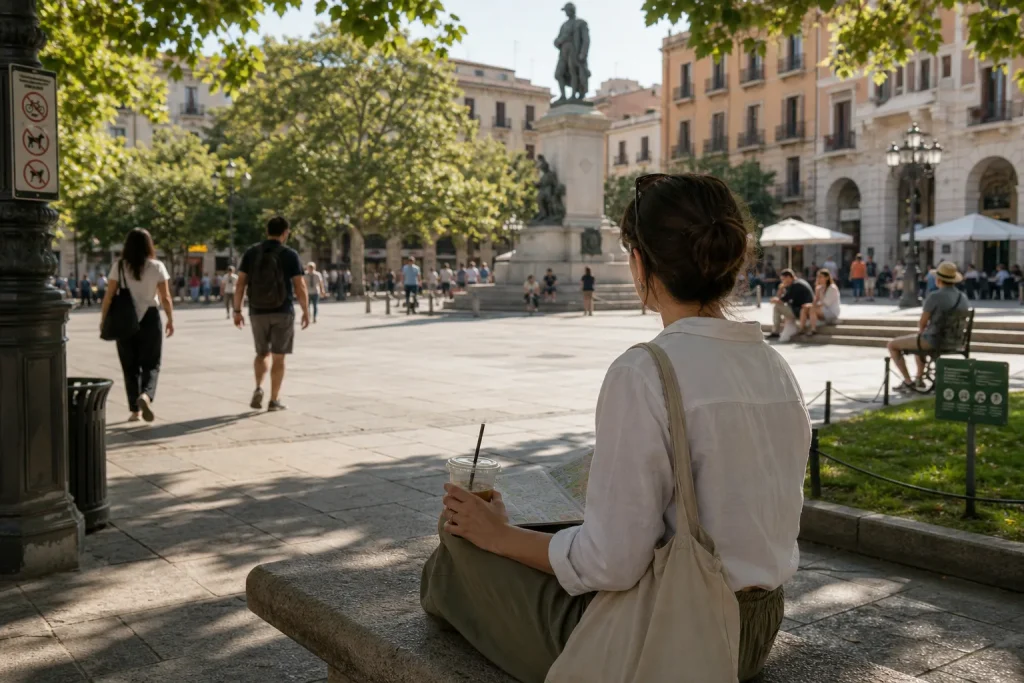
A public square can seem self-explanatory: open space, paths, benches and perhaps a monument or café. But its meaning is rarely contained in one feature. People may be crossing it on their way to work, meeting friends, resting between errands or gathering for an event. As a visitor, you can learn a lot by paying attention to these patterns—provided you treat what you see as clues rather than a complete account of local life.
Reading a square is not a puzzle to solve or a performance to document. It is a way to orient yourself, notice how the place works and make choices that leave room for others. A few common mistakes can lead to confident but shallow conclusions. The checklist below offers a slower, more considerate approach.
Begin with movement, not monuments
A prominent statue or fountain can draw the eye, but the square’s everyday purpose may be clearer in its routes. Look for where people enter, which paths they follow and where they slow down. A broad paved strip may be a practical shortcut; a shaded edge may invite a pause. These details suggest how the space accommodates movement and rest, without telling you everything about why it was designed that way.
A common mistake is to stand in a busy route while studying the layout. Move to an edge where you can see without obstructing anyone. Notice whether people avoid a particular area, follow worn paths or gather near a doorway. Treat each observation as provisional: a quiet corner could be peaceful, temporarily empty or simply less convenient at that moment.
Read features as clues, not verdicts
Benches, steps, trees, paving and signs shape what visitors can do. A bench facing a walkway may suit people-watching; low steps may double as informal seating; a canopy may offer shade or shelter. Ask what each feature makes easier, and for whom. Also notice what is absent: limited seating, narrow routes or a lack of shade may affect the experience of older visitors, families, workers and people with mobility needs.
Avoid turning one design detail into a sweeping claim about local values. A fence might protect plantings, guide a queue or mark an area closed for maintenance. Read posted information, look for context and leave room for uncertainty. If a feature seems confusing, you can simply describe what it does in practice rather than guessing at the intention behind it.
Notice the square’s changing rhythms
Public spaces are used differently across the day and in response to weather, school schedules, work routines or events. If you have time, observe for a little while rather than deciding what a square is like from a single glance. Watch how people arrive and leave, whether groups form around a particular activity, and how the mood shifts between its center and edges. Keep attention discreet; the aim is to understand the space, not to study individuals.
One mistake is to treat a moment of quiet as evidence that a square is unused, or a busy gathering as its permanent character. A market, ceremony or demonstration may change access and atmosphere. If you arrive during an event, follow signs and instructions, avoid blocking entrances, and consider whether sightseeing is appropriate. When the purpose is unclear, observing from a respectful distance is a sound choice.
Notice who can use the space comfortably
Look beyond whether a square appears welcoming to you. Are entrances easy to identify? Is there a step-free route? Can someone find a place to sit, get out of the sun or move through without weaving around café furniture? These practical details reveal how access is shaped. You do not need to assess the place as an expert; simply notice which features help or complicate ordinary use.
Be cautious about interpreting who belongs based on appearance or occupation. A person resting alone, a group speaking another language or a worker taking a break is not a symbol for you to decode. Do not photograph people at close range without consent, and never assume that a public setting makes every moment public property. Focus your attention on the layout and shared activity rather than turning strangers into scenery.
Follow visible rules and local signals
Signs are the clearest starting point for understanding what is allowed. Check notices about restricted areas, events, play, food or photography, and pay attention to barriers and staff directions. Rules may protect fragile landscaping, maintain a clear route or accommodate a scheduled gathering. If no sign answers your question, choose the lower-impact option: keep pathways open, use bins, and avoid climbing on features that appear decorative or commemorative.
Local behavior can offer additional context, but it is not a substitute for posted guidance. If people sit on steps, that may be a normal use; if an area is cordoned off, do not follow someone through because others seem to be nearby. When you are unsure, ask a staff member or choose another place to pause. A respectful visit does not require knowing every custom; it requires noticing limits and responding without entitlement.
Use a checklist before settling in
Before choosing where to sit, take a moment to check the square’s practical signals. Check the signs and barriers; if access is restricted, stay outside the marked area. Check the main routes; if your chosen spot would narrow a busy passage, move to the edge. Check nearby seating and shade; if those are scarce, avoid occupying a useful shared place longer than you need. Check for event activity; if a gathering is underway, give it room and follow its directions.
Also check whether your camera, food or conversation might intrude on others. If people are close by, frame the architecture instead of photographing them, and keep noise modest. The decision is not about finding a perfect visitor position; it is about choosing one that fits the conditions you can see. If the square feels crowded or the rules remain unclear, keep moving and return when it is more suitable.
A hypothetical worked example
Imagine a visitor arriving at a paved square on a warm afternoon with a map, a drink and time to pause. The central path is busy, a small lawn is bordered by a sign, and benches near a tree are occupied. The visitor first reads the sign rather than stepping onto the lawn, then watches the flow from an open edge. They notice a wider route leading to a quieter bench beside a wall.
They choose that bench, keep their bag beside their feet, and leave the path clear. When a group begins assembling nearby, they move on rather than treating the bench as a reserved viewing seat. The expected result is a short rest with minimal disruption and a more useful understanding of the square’s routes. The tradeoff is that the visitor may miss a closer view of the central feature; respecting the shared space matters more than securing the best vantage point.
Reading a public square well means holding observation and humility together. Notice where people move, what the design allows, how access works and which rules are visible—but resist turning a passing scene into a definitive story about a place. Your most useful decisions may be modest: stand clear, choose a suitable seat, follow a notice or put the camera away. That kind of attention makes a visit richer without asking the square or its regular users to perform for you.